
 look book

latest
habitat tv

Say goodbye to the morning scramble for keys, coats and sunglasses and hello to this… see this and more videos
blog
Reader roundup: Public murals and powder blues
A Morningside mural, an exterior refresh, and striped walls. Let these projects be your inspiration… more
More than the sum of its parts
10 Mar 2026
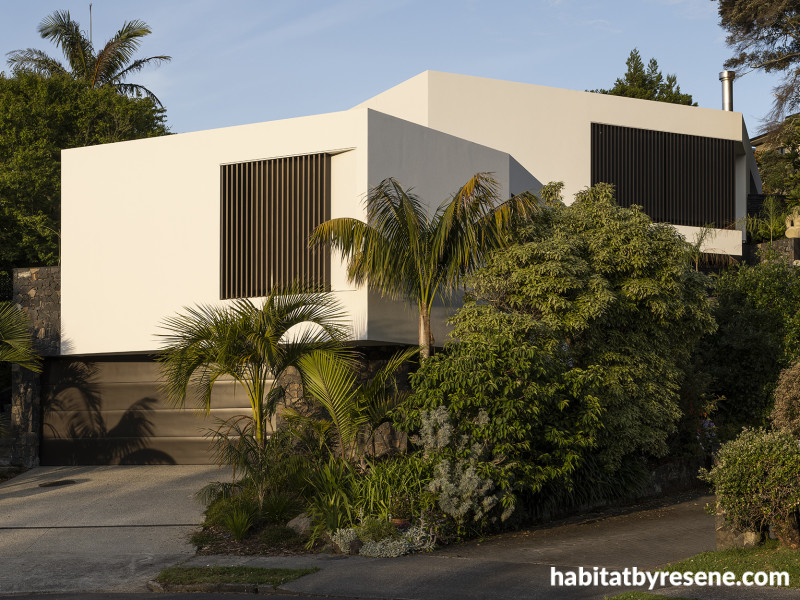
When you first encounter Berowald Place Home by Young+Richards+ you cannot help but stop in your tracks, drawn up short by the audacity of its forms, the crispness of every line and the contrast of its monochromatic façade set against the lushness of its established setting.
“From the street, all you see is what you believe are two blank cubes; defined and volumetric, much like a Donald Judd sculpture that has rolled down the hill and come to rest,” says the home's designer Elvon Young.
“It is only when you walk up to the house that you realise there is a pathway off to the right that gently leads you up a series of stairs, like you're climbing a dry riverbed, to the first-floor entry.”
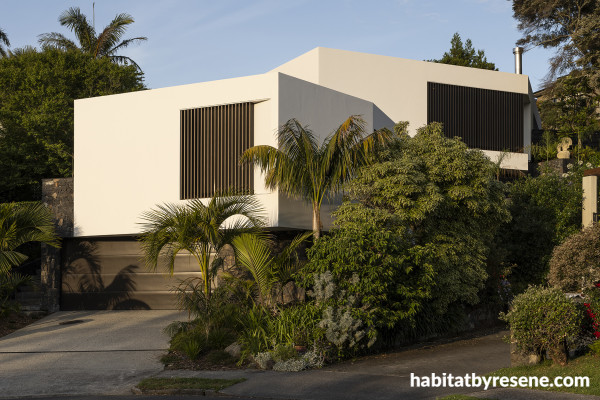
Designed by Elvon Young of Young+Richards+, this home presents a very formal, if somewhat surprising, sculptural façade to the streetscape, belying its true level of transparency.
Elvon says the steep, south-facing trapezoidal site was the perfect canvas for creating a home that provided the family and their guests with a series of experiential encounters that played with the idea of perspective and sensation.
“On first encounter, at street level, the home appears as a very formal gesture, recognisable yet surprising in form, and then what we've attempted is to take that solid form and dematerialise it into pure experience because when you're in this house there's no sensation of form, there's only the sensation of experience.
“Central to this is the relationship to light and so the shape of the house is designed to track the sun as it moves across the day. Essentially, you're taking a cold, south-facing site and threading light through it, bathing it in light.
“Of equal importance is the relationship to the landscape. In responding to the constraints of the site, the house is a series of rectangles that intersect one another while also traversing the slope as a means of maximising its relationship with the landscape, and so, in an abstract sense, the spatial sensation of moving through the house is also the spatial sensation of moving across the land.”
In keeping with the ethos of ‘people, place and space’ that informs the work of Young+Richards+ and which facilitates the interactions, relationships and rituals that encompass the human experience, Elvon says the design is an exploration of opposites, in which the house presents as both a solid and a void, both public and private.
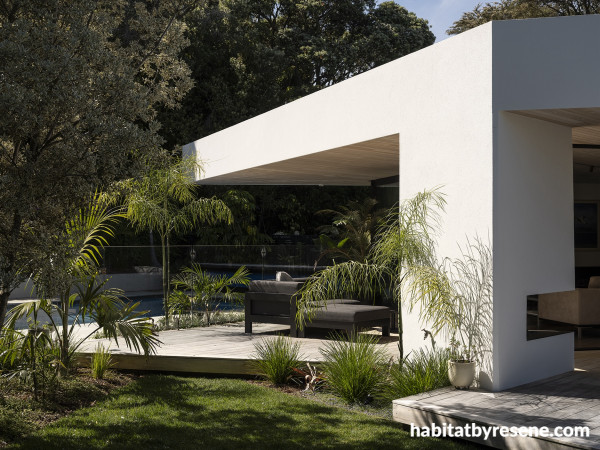
Conceived as light and shadow, mass and void, the house required a cladding material that could befittingly convey this dichotomy – the Integra AAC lightweight concrete façade system by Resene Construction Systems, finished in ROCKCOTE Classico coloured plaster, was identified as the ideal solution.
“It's very public in that it jumps out at you because it's so sculptural, yet it's also incredibly private for the same reason. There's no point at which you can see into the house itself from the outside, however, when you're inside the house the reverse is true, you can see other people, because we’ve built a high level of porosity into the fabric of the home.
“Where the house is particularly successful is that it continues to mete out these surprising encounters, so that every corner you turn, another encounter occurs. We were very deliberate in wanting those ‘chance meetings’ to occur again and again and again because, generally, life at home is about days and days and days where you're repeating the minutiae that that entails and so we wanted it to be special every single day.
“Elements such as the internal entrance from the garage, for example. In most instances where you have an internal-access garage, there is no sense of arrival, you simply walk through the garage and in through a side door, there's nothing special about that at all and yet the guest entrance from the street is usually a lot more experiential.
“So, with this house, we removed the barrier to that experience by inserting a glass wall between the entrance for guests – the stairs on the outside for visitors to walk up – and the stairs from the garage, so you get to experience the same feelings, each time, that someone would experience for the first time, it's kind of magical.”
Creating something with a high level of experiential intent takes a precise understanding of materiality and how diverse materials intersect to create a cohesive whole.
“The material palette for this home was purposely pared-back – a rock ‘veneer’ on a base of concrete block, glazing, masonry overlay, a timber soffit and a membrane roof over the top.
“In terms of the façade, because very early on in the design process we had envisaged the home as a sculptural, elemental form, that was described through light, shadow, volume and proportion, the Resene Integra AAC lightweight concrete façade system was the most appropriate solution in realising this, as it delivered all of these aspects.
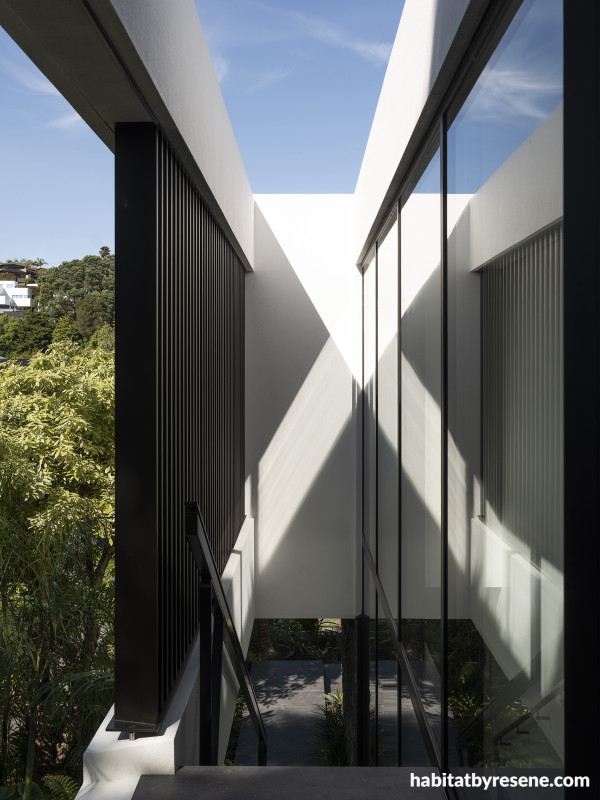
Behind the sculptural façade, ample glazing and open apertures bring light into the home and create a dialogue between the built and natural environments, allowing for ever-changing encounters every day.
“Also, from a technical standpoint, we like the fact that with the Integra system – essentially it's an aerated concrete building with a plaster finish to the outside and a cavity system behind – you get all the benefits of it being a lightweight concrete building, while having a conventional make-up behind to allow for appropriate building performance and ease of construction.
“Because Integra really is the only vertical material – Integra and the glazing – we worked closely with the technical teams from Resene and for the glazing to ensure that all the details were correct and provided the level of finish that we and the clients required.”
Images: David Straight
Published: 10 Mar 2026