
 look book

latest
habitat tv

Say goodbye to the morning scramble for keys, coats and sunglasses and hello to this… see this and more videos
blog
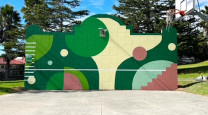
Reader roundup: Public murals and powder blues
A Morningside mural, an exterior refresh, and striped walls. Let these projects be your inspiration… more
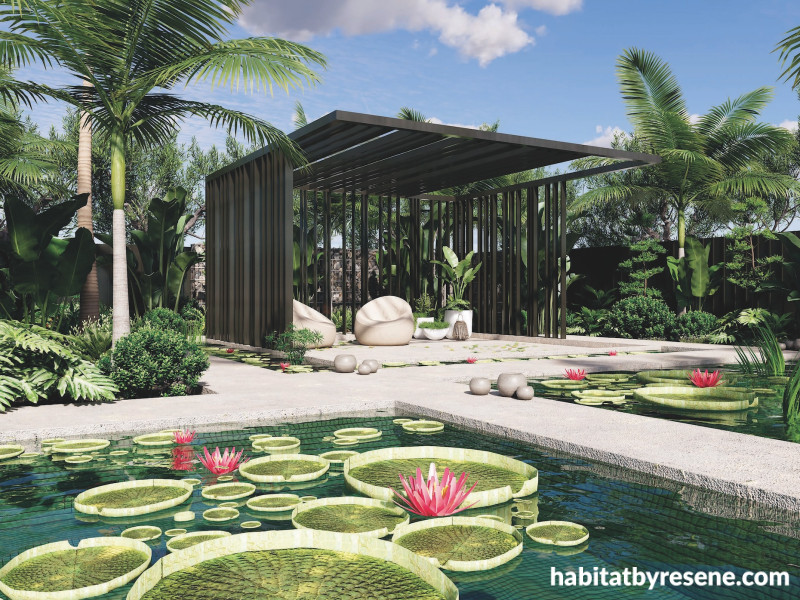
Kentia palms, Philodendron, Acacia and Buxus lend form and structure to this Balinese-inspired residential design. Small green porcelain tiles frame the pond areas, adding depth to the shallow ponds. Concrete paths guide one through the landscape to the bespoke seating area where a custom metal pergola anchors the design, giving purpose and scale to the garden.
Outlook Landscapes - Dean Philip Saunders
17 Jul 2026
Melbourne-born, Auckland-based landscape designer, Dean Philip Saunders, has spent the past 30 years creating award-winning landscapes for a variety of clients in both countries. With a passion for neoclassical design, Dean blends formal sensibilities with modern lifestyles to bring his clients’ visions to life. We sat down with Dean recently to talk all things landscaping and how Resene systems benefit his work.
What is a common misconception about your profession?
People often think a landscaper is the same as a landscape designer—they’re not, the two are very, very different. Designers plan and develop concepts first, then bring in skilled landscapers to execute. A key part of my role is educating clients on these differences and guiding them from consultation through to construction.
How does the process work in terms of collaborating with other design professionals?
There are a few different ways it can work, for example, I’m working on a new-build project at the moment where the client has engaged an architect and an interior designer and employed me to do the landscaping. The architect does the foundational work of the design – what it’s going to look like, what it’s going to feel like – and then the interior designer and myself will put our spin on it. My role is to ensure the outdoor space aligns seamlessly with the home’s design, maintaining a consistent language throughout.
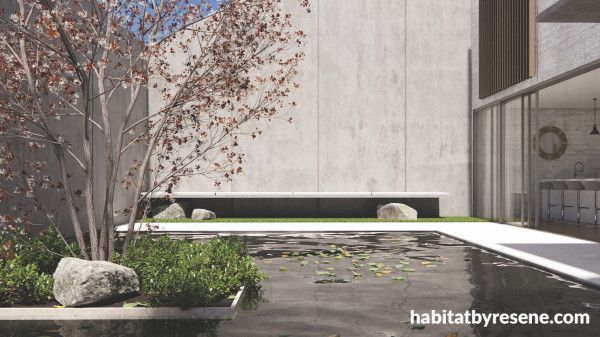
A shallow ‘mirror pond’ creates a visual reference point, changing colour throughout the day, while providing a peaceful contrast to the concrete surfaces within this confined landscape. The central garden, understated and refined, provides a focal point within the space. Gardenia’s and a Prunus Sargentii tree hold sway over the garden area.
How does it work for a garden remodel without other designers involved?
We focus on understanding how the client lives – whether they entertain a lot, whether they’re wanting to stay on in the house or whether they’re looking to sell. From there, start to put a brief together that is very much our take on what they’ve told us, using our design experience to fine-tune that brief and actually make it better than what the client originally intended. The goal is always to elevate their vision into something better.
Are there such things as landscape fads, or does landscape design stay fairly static, in terms of what people like or what people want?
There are definitely fads, and there are designers out there who only deal with fads, so they’re constantly looking at what’s in vogue and they’ll only design gardens with that intention. I’m more of a traditional designer. My designs draw upon a long-held vernacular, which is a very formal, very structured kind of garden design. Using that as a blueprint, I adapt that traditional design into something specific to each client.
You work across New Zealand and Australia, are the two markets similar or are they completely different?
Australia and New Zealand are very different cultures and very different climates. Australians – especially in Melbourne – favour more formal, European-inspired designs, while New Zealanders are more open to native, less structured gardens. That said, with the smaller sections we’re seeing with new developments, the more formal approach is coming to the fore.
Does this mean outdoor spaces are becoming more functional?
Yes. As sections shrink, outdoor areas are now increasingly being seen as an extension to indoor living. We design them as integrated indoor-outdoor spaces rather than separate gardens.
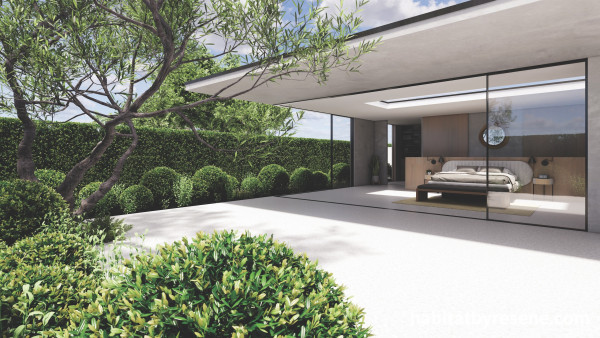
Formal Buxus topiary balls create drama within the space, while the clipped Ficus Tuffy hedge serves to frame the landscape. The existing Olive tree sits proud as an anchor point to the entertaining space, drawing the eye up to the open spaces beyond.
What’s a common client mistake?
Underestimating cost and complexity. Clients often want a lot with a small budget, so education around realistic expectations is essential.
When should landscaping be considered in a new build?
As early as possible. Early involvement allows better integration with the house and can avoid costly changes later. I have a project in Melbourne where the clients got me involved early on, and, as it turned out, it was lucky they did because there were windows and ranch sliders that we had to move around in order to better connect their living spaces to the outdoors. If they had gone ahead and built the house first and then thought of the landscape, they wouldn’t have that gotten the level of connection that they did.
Is there such a thing as too small a space?
No. Even very small areas can work well if you define their purpose. Sometimes a small space can only be one thing, which may be a seating area, so rather than trying to make it something that it’s not, you’ve got to work within those parameters to create a space the client wants to be in.
You are a proponent of Resene systems. What is it about them that makes you keep coming back?
Since I started designing landscapes, I was always drawn to premium products which reflected my aesthetic and styling. Resene offers high-quality products, a wide palette, and expert support, all of which help bring my designs to life.
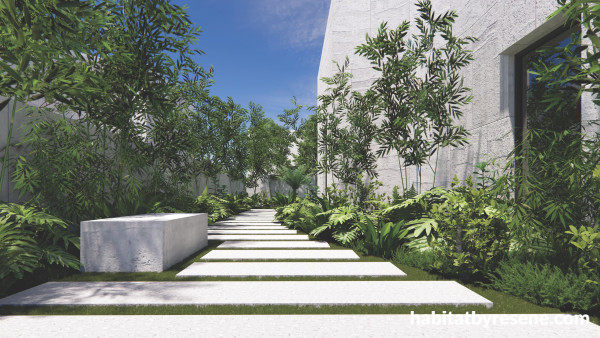
Bold, architectural planting mirrors the bold lines of the home. Layers of Bamboo, Philodendron, Ligularia, Ilex and ferns provide texture and form throughout. Selective garden up lighting transforms the landscape in the twilight hours.
What products in particular are your ‘go tos’?
My absolute favourite Resene products are from their textures range. Resene Sandtex is an easy to apply subtle texture that can mimic rendered concrete and renders. It is great for bare bland walls (and can be used on both inside and exterior surfaces making it ideal for walls that transition from interior to exterior). I also like using dark timber stains from the Resene Woodsman range, especially “Pitch Black”; which I use for fencing and accents to really make the planting schemes pop. Dark colours create depth and can help blur the line between foreground and background.
What colours do you gravitate towards?
Depending on the project, I utilise an array of colours from natural hues through to vibrant eclectic tones. We have even used the Resene FX Metallic range in Blast Grey, Dimension and The Ritz for under cover outdoor kitchen spaces
project Dean Philip Saunders – Outlook Landscapes LTD
Published: 17 Jul 2026