
 look book

latest
habitat tv

Say goodbye to the morning scramble for keys, coats and sunglasses and hello to this… see this and more videos
blog
Reader roundup: Public murals and powder blues
A Morningside mural, an exterior refresh, and striped walls. Let these projects be your inspiration… more
Bringing history to life
17 Feb 2026
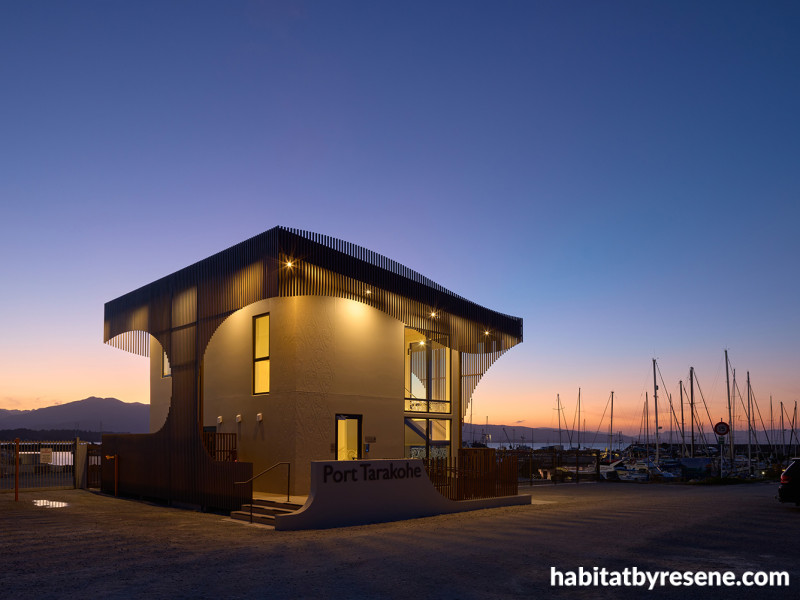
Situated beneath the culturally significant limestone bluffs of Golden Bay, sits an unassuming building, small in stature but immense in its significance – both functionally and symbolically.
Part of the Port Tarakohe upgrade commissioned by Tasman District Council, the new Harbour Master and Public Amenity Building provides the operational clarity, public access and resilience that the expanded marine infrastructure depends on, says JTB Architects’ principal, Simon Hall.
“Despite the building’s modest footprint, it services the commercial marina and port users and houses commercial port office operations with oversight of the marina and bay.
“In practical terms, within the wider $13 million redevelopment, which delivers larger commercial berths, extended breakwaters, upgraded fuel systems and improved aquaculture capacity, it is the operational centre that connects people, vessels and upgraded infrastructure.”
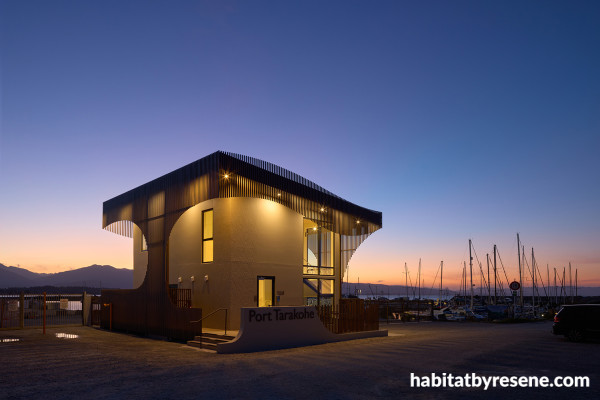
Designed by JTB Architects, the Port Tarakohe Harbour Master and public amenity building features architectural elements in the form of elevated screens, which reference pā palisades, along with honu (sea turtle) and further motifs drawn directly from those carved into the Anaweka Waka – a 700-year-old waka discovered buried in a Golden Bay sandbank in 2012. Photo by Jason Mann.
Given the environmentally sensitive nature of the site and marine setting, the architects were acutely aware that material selection would play a vital role in the success of the project.
“For Port Tarakohe, durability and long‑term performance were non‑negotiable. The site’s coastal environment demanded a façade system that could withstand constant exposure to salt air, wind and moisture while still delivering a refined architectural finish. The Resene INTEGRA AAC Plaster Façade System, with its proven resilience and ability to maintain a high‑performance weather envelope, offered that balance.
“The system’s lightweight AAC panels also support our broader sustainability and performance goals. Their acoustic and thermal benefits, which help to reduce external noise and improve energy efficiency, contribute to a more comfortable interior environment for users of the port facilities.”
Originally settled around 1300, Golden Bay quickly became important to Mãori as a place for coming together, either for trade of natural resources such as quartzite and iron oxide, or for the gathering and sharing of kai moana. More recently, it was the original site of Golden Bay Cement, having been established in 1908.
Aesthetically, the design draws heavily on the layered history of Port Tarakohe, reflecting both its deep cultural significance to local iwi and its more recent industrial past, says Simon.
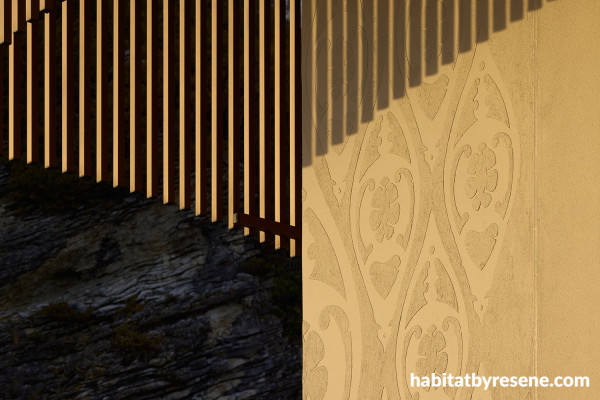
The Resene INTEGRA AAC Plaster Façade System was specified for its proven resilience and ability to maintain a high‑performance weather envelope. An Ezytex float was hand-applied to the façade in a pattern designed by artist Robin Slow. Photo by Jason Mann.
“Working in close collaboration with Manawhenua Ki Mohua and artist Robin Slow, architectural elements in the form of elevated screens reference pā palisades, while honu (sea turtle) and further motifs connected to Anaweka Waka – a 700-year-old waka discovered buried in a Golden Bay sandbank in 2012 – etched into plaster and integrated into window details, express themes of navigation, protection and belonging.
“The embossed finish, was developed as a way to integrate cultural storytelling into the façade through a textured, lightresponsive surface. The resulting relief work echoes the textured limestone cliffs surrounding the site, with the embossed forms capturing light and shadow in a similar way. This creates a dynamic surface that evolves with weather and season, anchoring the building within its landscape and reinforcing the visual narrative embedded in its form.”
Colour, too, was integral to the design intention of creating a building that harmonises with its landscape.
“The project used colour to enhance the architectural expression. Resene Double Akaroa, chosen for its soft, mineral tone that mirrors the limestone cliffs and complements the etched honu and waka hoe motifs, was applied to the plaster cladding, while the soffits were finished in Resene Element, a neutral, earthy tone that frames the layered edges of the building, highlights shadowing and harmonises with the surrounding coastal landscape.
“Darker complementary Resene tones were used on the elevated screens to reference the palisades of traditional Māori pā sites, providing visual contrast while reinforcing themes of protection and guardianship. All coatings were chosen to withstand harsh coastal conditions while maintaining the intended aesthetic and cultural expression
“In short, we chose the Resene INTEGRA AAC system, in conjunction with the Ezytex float, because it delivers what this project demanded: durability, tested performance, coastal resilience and a finish that reflects the quality and identity of the new port.”
Published: 17 Feb 2026